1K
Loading Reference Work…
“Biblical monarch of ancient Israel”
Solomon, also called Jedidiah, was a king of ancient Israel. The successor of his father David, he is described as the penultimate ruler of all Twelve Tribes of Israel under a united Israel and Judah. His reign is hypothesized to have lasted from c. 970–931 BCE. According to the biblical narrative, his reign brought commercial prosperity through alliances and trade, but his accumulation of wealth, horses, and foreign wives, many of whom introduced idolatry, led to divine punishment. After Solomon's death, his son Rehoboam’s harsh policies led the northern Israelites to reject the Davidic line and follow Jeroboam, splitting the kingdom into Israel in the north and Judah in the south, according to the Hebrew Bible.
Israel’s public worship took place in mobile tents and local sacrificial high places (*bamot*), while the young monarchy lacked administrative sophistication, monumental stone architecture, and global trade networks.
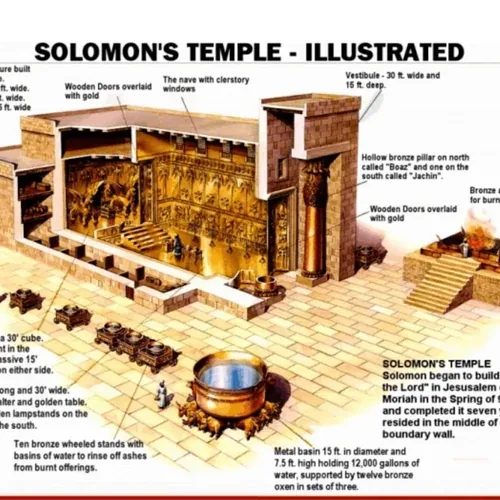
Solomon constructed the First Temple in Jerusalem on Mount Moriah, centralizing national worship, established international diplomatic and commercial treaties from Phoenicia to Sheba, and cultivated judicial wisdom and proverbs.
Permanently enshrined the Temple in Jerusalem as the heart of Jewish spiritual longing for three millennia, established the biblical genre of Wisdom Literature (*Hokhmah*), and created the classical archetype of the wise philosopher-king.
Tracing the downstream transmission from Solomon’s initial intervention through immediate adapters, institutionalization, and enduring consequences in human history.
Solomon constructed the First Temple in Jerusalem on Mount Moriah, centralizing national worship, established international diplomatic and commercial treaties from Phoenicia to Sheba, and cultivated judicial wisdom and proverbs.
Rulings, codes, and hermeneutic principles incorporated into yeshiva curricula and communal adjudication.
Commentaries, codes, and responsa accepted as authoritative standards by Diaspora communities.
Transmitted the unified monarchy, Jerusalem sanctuary plan, and psalmodic legacy.
Under editorial review.
Without Solomon, Israel would have lacked the physical and architectural anchor of the First Temple, leaving sacred worship decentralized and far more susceptible to Canaanite syncretism and early dispersal.
How many people, institutions, societies, or disciplines were affected?
Solomon: Analyzes the socio-theological significance of the Temple dedication prayer as a universalist charter welcoming all nations to pray to the God of Israel.
[1 Kings 8:22–53] Solomon’s prayer at the Temple dedication: asking that God hear prayers offered toward this house, including prayers of the foreigner.
[Proverbs 1:1–7] Preamble to wisdom: "The fear of the Lord is the beginning of knowledge; fools despise wisdom and instruction."
Solomon’s prayer at the Temple dedication: asking that God hear prayers offered toward this house, including prayers of the foreigner.
Preamble to wisdom: "The fear of the Lord is the beginning of knowledge; fools despise wisdom and instruction."
Analyzes the socio-theological significance of the Temple dedication prayer as a universalist charter welcoming all nations to pray to the God of Israel.
Integrated into daily liturgy, lifecycle rites, and Jewish constitutional identity worldwide.
Permanently enshrined the Temple in Jerusalem as the heart of Jewish spiritual longing for three millennia, established the biblical genre of Wisdom Literature (*Hokhmah*), and created the classical archetype of the wise philosopher-king.
How fundamentally did they alter the structural state of the field or world?
Did the consequences endure decades, centuries, or millennia?
Did they introduce a genuinely new paradigm vs. incremental refinement?
Would this change have happened without this specific individual?
How crucial to Jewish civilization, Torah, ethics, or Israel?
Comprehensive multi-dimensional evaluation of civilizational reach, conceptual depth, duration of legacy, and historical causation across Jewish and world history.