1K
Loading Reference Work…
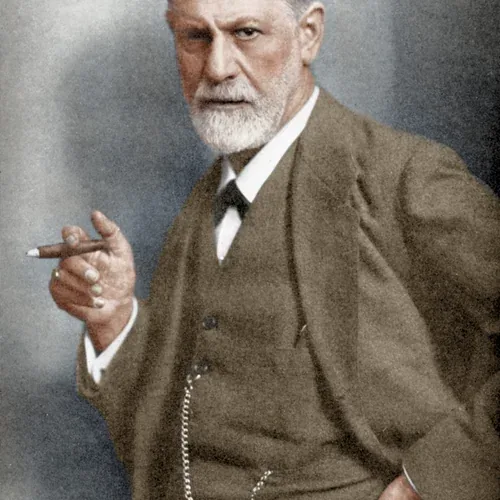
“The founder of psychoanalysis, who revolutionized the modern conception of human nature by mapping the unconscious mind, dreams, repression, and psychological defense mechanisms.”
Sigmund Freud (1856–1939) was an Austrian neurologist who founded psychoanalysis, a clinical method for evaluating and treating psychopathology through dialogue between a patient and a psychoanalyst. Formulating theories of the unconscious mind, the Id, Ego, and Superego, the Oedipus complex, and the interpretation of dreams, Freud revolutionized 20th-century psychiatry, literature, art, and philosophy.
Human psychology and mental illness were viewed through anatomical lesions, moral failings, or purely conscious introspection, ignoring the subterranean drives of the psyche.
Founded psychoanalysis, mapped the unconscious mind (id, ego, super-ego), formulated the mechanisms of psychological repression, defense, and transference, and deciphered the language of dreams.
Permanently reconfigured Western culture, literature, art, philosophy, and clinical psychology, making the unconscious mind central to the modern conception of the human self.
Tracing the downstream transmission from Sigmund Freud’s initial intervention through immediate adapters, institutionalization, and enduring consequences in human history.
Founded psychoanalysis, mapped the unconscious mind (id, ego, super-ego), formulated the mechanisms of psychological repression, defense, and transference, and deciphered the language of dreams.
Published treatises and dialectic essays debated across academies, courts, and international peer networks.
Adopted by subsequent generations of thinkers, writers, and artists who built directly upon these foundational concepts.
Developed free association and talk therapy to address neurosis and psychological distress.
Mapped the tripartite dynamics of id (instincts), ego (reality), and super-ego (conscience/internalized culture).
Introduced the theory of the unconscious mind and dream analysis as the royal road to unconscious knowledge.
Formulated the tripartite structural model of the human psyche: id, ego, and super-ego.
Explored the irreconcilable friction between individual instinctual freedom and civilizational conformity.
Primary foundational figure.
Freud’s analysis of the Oedipal complex, guilt, and the subconscious deeply informed Kafka’s letters and fiction.
Psychoanalytic concepts of mass psychology and totalitarian conformity analyzed in Arendt’s political theory.
Methodological Standard: Jewish identity is strictly documented and never inferred from surnames, physical appearance, geography, or stereotypes. Every profile separates identity claims from verified sources.
Born Sigismund Schlomo Freud in Freiberg, Moravia to Galician Jewish parents Jacob Freud and Amalia Nathansohn.
Unbroken Jewish parentage; active member of B’nai B’rith in Vienna; fled Nazi persecution to London in 1938.
Without Freud, the clinical exploration of psychological trauma, developmental dynamics, and unconscious cognition would have remained marginal in 20th-century medicine and culture.
How many people, institutions, societies, or disciplines were affected?
Freud lived and practiced at Berggasse 19 in Vienna for 47 years until escaping Nazi persecution in 1938.
Authoritative analysis of Freud’s Viennese intellectual formation, Jewish secular identity, and psychoanalytic revolution.
Incorporated into the permanent canon of human civilization, political philosophy, or world literature.
Permanently reconfigured Western culture, literature, art, philosophy, and clinical psychology, making the unconscious mind central to the modern conception of the human self.
How fundamentally did they alter the structural state of the field or world?
Did the consequences endure decades, centuries, or millennia?
Did they introduce a genuinely new paradigm vs. incremental refinement?
Would this change have happened without this specific individual?
How crucial to Jewish civilization, Torah, ethics, or Israel?
Created the modern psychological paradigm and transformed Western understanding of the self.