1K
Loading Reference Work…
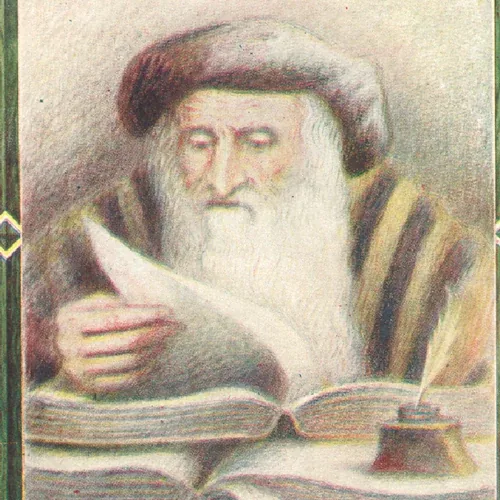
“The master commentator of Jewish civilization, whose verse-by-verse commentaries on the Hebrew Bible and the Babylonian Talmud unlocked the texts for all subsequent generations.”
Rabbi Shlomo Yitzchaki (1040–1105), revered by the acronym Rashi, was born in Troyes, France. Operating a vineyard to support himself, Rashi composed comprehensive running commentaries on nearly the entire Tanakh (Hebrew Bible) and Babylonian Talmud. With peerless brevity, grammatical precision, and psychological sensitivity, Rashi made the formidable dialectic of the Talmud accessible to every student, ensuring the survival and continuity of Jewish learning through the harrowing massacres of the First Crusade.
The Babylonian Talmud was an esoteric, unpunctuated Aramaic text accessible almost exclusively to insular academies; without an authoritative guide, regional traditions were growing increasingly disconnected.
Rashi authored a running, word-by-word commentary on the Talmud and Tanakh, elucidating archaic grammar, establishing correct manuscripts, and synthesizing midrashic lore with simple plain meaning (peshat).
Every printed edition of the Babylonian Talmud since the 15th century (including the Romm/Vilna edition) places Rashi’s commentary on the inside margin; Christian Hebraists (Nicholas of Lyra) used Rashi, directly influencing Martin Luther’s Bible translation.
Tracing the downstream transmission from Rashi (Rabbi Shlomo Yitzchaki)’s initial intervention through immediate adapters, institutionalization, and enduring consequences in human history.
Rashi authored a running, word-by-word commentary on the Talmud and Tanakh, elucidating archaic grammar, establishing correct manuscripts, and synthesizing midrashic lore with simple plain meaning (peshat).
Rulings, codes, and hermeneutic principles incorporated into yeshiva curricula and communal adjudication.
Commentaries, codes, and responsa accepted as authoritative standards by Diaspora communities.
The universal companion commentary printed alongside the text in all standard editions of the Babylonian Talmud.
The first Hebrew book ever printed (Rome, 1475); the universal text taught to every Jewish schoolchild.
Incorporated over 3,000 Old French glosses (La’azim), making Rashi an essential primary source for Romance linguistics.
Primary foundational figure.
Rashi’s Talmudic elucidations laid the textual bedrock that enabled Maimonides to formulate the Mishneh Torah.
Rashi’s textual commentary provided the bedrock for all later halakhic codification.
Methodological Standard: Jewish identity is strictly documented and never inferred from surnames, physical appearance, geography, or stereotypes. Every profile separates identity claims from verified sources.
Born in Troyes, France; revered leader of Ashkenazi Jewry; father of scholarly daughters whose sons became the Tosafists.
Uncontested rabbinic lineage; revered universally across Ashkenazi and Sephardi traditions alike.
Without Rashi, the Talmud would have become an inscrutable relic accessible only to a tiny scholarly elite, likely severing the democratization of Jewish literacy.
How many people, institutions, societies, or disciplines were affected?
Rashi witnessed and provided spiritual rescue following the First Crusade massacres in the Rhineland (1096).
Nicholas of Lyra’s Postillae relied heavily on Rashi, leading to the adage: "Si Lyra non lyrasset, Lutherus non saltasset."
Integrated into daily liturgy, lifecycle rites, and Jewish constitutional identity worldwide.
Every printed edition of the Babylonian Talmud since the 15th century (including the Romm/Vilna edition) places Rashi’s commentary on the inside margin; Christian Hebraists (Nicholas of Lyra) used Rashi, directly influencing Martin Luther’s Bible translation.
How fundamentally did they alter the structural state of the field or world?
Did the consequences endure decades, centuries, or millennia?
Did they introduce a genuinely new paradigm vs. incremental refinement?
Would this change have happened without this specific individual?
How crucial to Jewish civilization, Torah, ethics, or Israel?
Incomparable pedagogical and textual centrality in Jewish life for over 900 years, with substantial influence on Western biblical translations.