1K
Loading Reference Work…
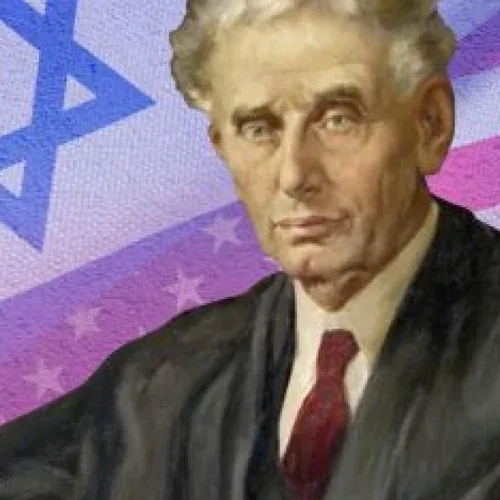
“The legendary "People’s Lawyer" and first Jewish U.S. Supreme Court Justice, who created the constitutional right to privacy and pioneered legal realism.”
Louis Dembitz Brandeis (1856–1941) was an American jurist, public advocate, and leader of the American Zionist movement. Appointed to the U.S. Supreme Court by Woodrow Wilson in 1916, Brandeis transformed jurisprudence through the "Brandeis Brief," which revolutionized constitutional law by marshaling empirical economic and sociological data alongside legal precedent. His historic dissents established the modern constitutional right to privacy, protected free speech against government censorship, and warned against the "curse of bigness" in corporate monopolies.
Constitutional law was dominated by abstract formalist legalism and laissez-faire property rights (Lochner era), while privacy had no explicit protection in American law.
Brandeis authored the seminal 1890 Harvard Law Review article "The Right to Privacy" ("the right to be let alone"), invented the empirical Brandeis Brief, and defended uncompromising freedom of political speech in Whitney v. California.
The right to privacy became the foundation for modern civil liberties and digital privacy rights; his economic critiques shaped the New Deal and anti-trust law.
Tracing the downstream transmission from Louis Brandeis’s initial intervention through immediate adapters, institutionalization, and enduring consequences in human history.
Brandeis authored the seminal 1890 Harvard Law Review article "The Right to Privacy" ("the right to be let alone"), invented the empirical Brandeis Brief, and defended uncompromising freedom of political speech in Whitney v. California.
Organized geopolitical congresses, petitions, and financial instruments establishing modern state infrastructure.
Catalyzed mass demographic return, infrastructure development, and institutional state foundations in Eretz Yisrael.
Co-authored with Samuel Warren; widely regarded as the most influential law review article ever published.
Pioneered the introduction of empirical scientific and social data into constitutional adjudication.
Classic concurring opinion declaring that the remedy for false speech is "more speech, not enforced silence."
Led the Provisional Executive Committee for General Zionist Affairs, multiplying American Zionist membership tenfold.
Herzl’s Zionist vision converted Brandeis to Zionism in 1914, leading Brandeis to head the American Zionist movement.
Brandeis’s pioneering legal realism and privacy jurisprudence directly inspired Ginsburg’s equal protection strategy.
Methodological Standard: Jewish identity is strictly documented and never inferred from surnames, physical appearance, geography, or stereotypes. Every profile separates identity claims from verified sources.
Born in Louisville, Kentucky to Adolph Brandeis and Frederika Dembitz, Jewish immigrants from Prague.
Lifelong recognized Jew; transformed American Zionism into a mass civic movement from 1914 to 1921.
Without Brandeis, American constitutional jurisprudence would have remained rigid, corporate-favoring, and lacking a coherent doctrine of privacy.
How many people, institutions, societies, or disciplines were affected?
Brandeis was confirmed as the first Jewish Justice of the U.S. Supreme Court on June 1, 1916.
Safeguarded Jewish collective survival and sovereign refuge following millennia of exile and dispersion.
The right to privacy became the foundation for modern civil liberties and digital privacy rights; his economic critiques shaped the New Deal and anti-trust law.
How fundamentally did they alter the structural state of the field or world?
Did the consequences endure decades, centuries, or millennia?
Did they introduce a genuinely new paradigm vs. incremental refinement?
Would this change have happened without this specific individual?
How crucial to Jewish civilization, Torah, ethics, or Israel?
Monumental architect of modern constitutional law, the right to privacy, and the mobilization of American Jewry behind Zionism.