1K
Loading Reference Work…
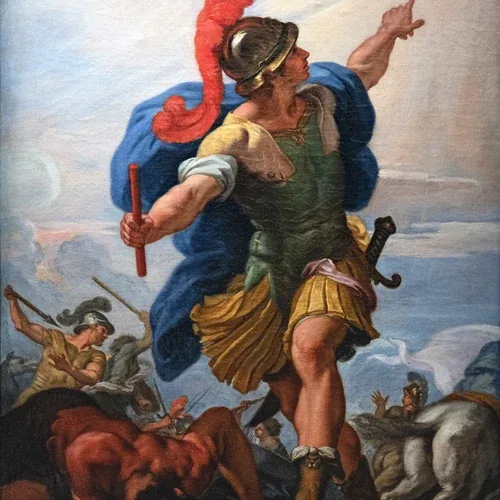
“Central figure in the Hebrew Bible's Book of Joshua”
Joshua, also known as Yehoshua, Jehoshua, or Josue, was Moses' assistant in the books of Exodus and Numbers, and later succeeded Moses as leader of the Israelite tribes in the Book of Joshua of the Hebrew Bible. His name was Hoshea the son of Nun, of the tribe of Ephraim, but Moses called him "Yehoshua", the name by which he is commonly known in English. According to the Bible, he was born in Egypt prior to the Exodus.
Israel was a nomadic refugee populace poised at the Jordan River after forty years in the Sinai wilderness, facing fortified Canaanite city-states and the acute risk of disintegration upon the death of Moses.
Joshua provided steadfast military leadership across the Jordan River, directed the conquest of strategic central, southern, and northern Canaanite fortresses, oversaw the equitable allotment of the land to the twelve tribes, and convoked the covenant renewal at Shechem.
Successfully transitioned Israel from wandering nomads into an agrarian nation anchored in its ancestral homeland, proving that the Torah’s covenantal promises were actionable in concrete human history.
Tracing the downstream transmission from Joshua’s initial intervention through immediate adapters, institutionalization, and enduring consequences in human history.
Joshua provided steadfast military leadership across the Jordan River, directed the conquest of strategic central, southern, and northern Canaanite fortresses, oversaw the equitable allotment of the land to the twelve tribes, and convoked the covenant renewal at Shechem.
Rulings, codes, and hermeneutic principles incorporated into yeshiva curricula and communal adjudication.
Commentaries, codes, and responsa accepted as authoritative standards by Diaspora communities.
Formal transmission of authority: Moses placed his hands on Joshua.
Under editorial review.
Without Joshua’s military acumen and unwavering fidelity, the Israelite tribes would likely have fractured upon Moses’s death, failed to cross the Jordan, and dissolved back into the desert.
How many people, institutions, societies, or disciplines were affected?
Joshua: Analyzes Joshua as the archetype of the faithful disciple who implements the Torah’s terrestrial mandates and preserves national unity.
[Joshua 1:1–9] Commission of Joshua: "Be strong and courageous; do not be frightened or dismayed, for the Lord your God is with you wherever you go."
[Joshua 24:14–18] Covenant renewal at Shechem: "As for me and my household, we will serve the Lord."
Commission of Joshua: "Be strong and courageous; do not be frightened or dismayed, for the Lord your God is with you wherever you go."
Covenant renewal at Shechem: "As for me and my household, we will serve the Lord."
Analyzes Joshua as the archetype of the faithful disciple who implements the Torah’s terrestrial mandates and preserves national unity.
Integrated into daily liturgy, lifecycle rites, and Jewish constitutional identity worldwide.
Successfully transitioned Israel from wandering nomads into an agrarian nation anchored in its ancestral homeland, proving that the Torah’s covenantal promises were actionable in concrete human history.
How fundamentally did they alter the structural state of the field or world?
Did the consequences endure decades, centuries, or millennia?
Did they introduce a genuinely new paradigm vs. incremental refinement?
Would this change have happened without this specific individual?
How crucial to Jewish civilization, Torah, ethics, or Israel?
Comprehensive multi-dimensional evaluation of civilizational reach, conceptual depth, duration of legacy, and historical causation across Jewish and world history.