1K
Loading Reference Work…
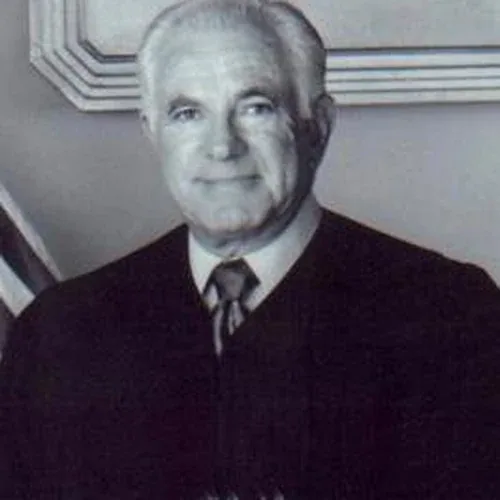
“American reality court show judge (1919–2017)”
Joseph Albert Wapner was an American judge and television personality. He is best known as the first presiding judge of the reality court show The People's Court. The show's first run in syndication, with Judge Wapner presiding as judge, ran from 1981 to 1993, for 12 seasons and 2,340 episodes. Although the show's second run was presided over by multiple judges, Wapner was the sole judge to preside during the show's first incarnation. His tenure on the program made him the first jurist of arbitration-based reality court shows, which evolved into the most popular trend in the judicial genre and continues to be to the present.
Legal frameworks often lacked constitutional safeguards for individual rights, common law precedents, and equal protection under the law.
Penned landmark judicial opinions, statutory codes, or jurisprudence that fortified civil liberties and constitutional democracy.
Their legal philosophy and constitutional precedents continue to guide high courts and jurisprudence worldwide.
Tracing the downstream transmission from Joseph Wapner’s initial intervention through immediate adapters, institutionalization, and enduring consequences in human history.
Penned landmark judicial opinions, statutory codes, or jurisprudence that fortified civil liberties and constitutional democracy.
Published treatises and dialectic essays debated across academies, courts, and international peer networks.
Adopted by subsequent generations of thinkers, writers, and artists who built directly upon these foundational concepts.
Without their jurisprudence, the modern protection of civil liberties and constitutional checks would be markedly weaker.
How many people, institutions, societies, or disciplines were affected?
Incorporated into the permanent canon of human civilization, political philosophy, or world literature.
Their legal philosophy and constitutional precedents continue to guide high courts and jurisprudence worldwide.
How fundamentally did they alter the structural state of the field or world?
Did the consequences endure decades, centuries, or millennia?
Did they introduce a genuinely new paradigm vs. incremental refinement?
Would this change have happened without this specific individual?
How crucial to Jewish civilization, Torah, ethics, or Israel?
Comprehensive multi-dimensional evaluation of civilizational reach, conceptual depth, duration of legacy, and historical causation across Jewish and world history.