1K
Loading Reference Work…
“Given name”
Joseph is a common male name, derived from the Hebrew Yosef. "Joseph" is used, along with "Josef", mostly in English, French and partially German languages. This spelling is also found as a variant in the languages of the modern-day Nordic countries. In Portuguese and Spanish, the name is "José". In Catalan it is "Josep". In Arabic, including in the Quran, the name is spelled يوسف, Yūsuf. In Kurdish (Kurdî), the name is Ûsiv or Yûsiv, Persian, the name is Yousef, and in Turkish it is Yusuf. In Pashto the name is spelled Esaf (ايسپ) and in Malayalam it is spelled Ousep (ഔസേപ്പ്). In Tamil, it is spelled as Yosepu (யோசேப்பு).
The twelve sons of Jacob were consumed by bitter jealousy and fractured by violence, threatening the moral cohesion of the family, while the ancient Near East was periodically wiped out by catastrophic famines.
Sold into Egyptian servitude, Joseph maintained unimpeachable moral integrity, interpreted Pharaoh’s prophetic dreams, orchestrated nationwide grain storage to save millions during a seven-year famine, and extended unconditional forgiveness to his brothers.
Preserved the nascent nation of Israel from starvation, settled them safely in the land of Goshen, and established the theological principle of divine providence (*hashgachah pratit*): "You intended to harm me, but God intended it for good."
Tracing the downstream transmission from Joseph’s initial intervention through immediate adapters, institutionalization, and enduring consequences in human history.
Sold into Egyptian servitude, Joseph maintained unimpeachable moral integrity, interpreted Pharaoh’s prophetic dreams, orchestrated nationwide grain storage to save millions during a seven-year famine, and extended unconditional forgiveness to his brothers.
Rulings, codes, and hermeneutic principles incorporated into yeshiva curricula and communal adjudication.
Commentaries, codes, and responsa accepted as authoritative standards by Diaspora communities.
Favor and foundational tribal leadership transmitted before Egyptian descent.
Under editorial review.
Without Joseph’s economic foresight and moral magnanimity, the family of Jacob would have starved in Canaan, aborting the Exodus, the Sinai revelation, and the entire future trajectory of Judaism.
How many people, institutions, societies, or disciplines were affected?
Joseph: Analyzes the Joseph novella as a literary and theological masterpiece illustrating the quiet operation of divine providence through administrative skill.
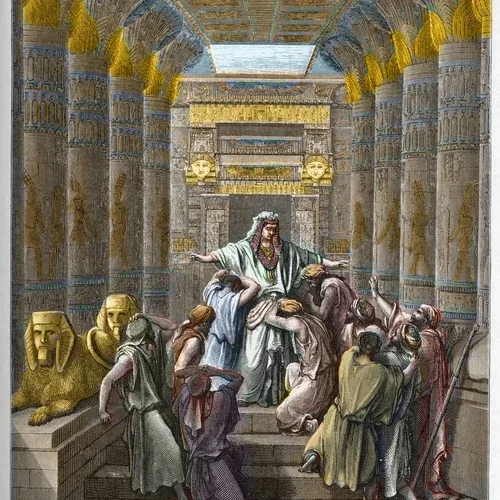
[Genesis 45:1–8] Joseph reveals himself to his terrified brothers in Egypt, articulating divine providence over human grievance.
[Genesis 50:19–21] The capstone of the Joseph narrative: "Even though you intended to do harm to me, God intended it for good, in order to preserve a numerous people."
Joseph reveals himself to his terrified brothers in Egypt, articulating divine providence over human grievance.
The capstone of the Joseph narrative: "Even though you intended to do harm to me, God intended it for good, in order to preserve a numerous people."
Analyzes the Joseph novella as a literary and theological masterpiece illustrating the quiet operation of divine providence through administrative skill.
Integrated into daily liturgy, lifecycle rites, and Jewish constitutional identity worldwide.
Preserved the nascent nation of Israel from starvation, settled them safely in the land of Goshen, and established the theological principle of divine providence (*hashgachah pratit*): "You intended to harm me, but God intended it for good."
How fundamentally did they alter the structural state of the field or world?
Did the consequences endure decades, centuries, or millennia?
Did they introduce a genuinely new paradigm vs. incremental refinement?
Would this change have happened without this specific individual?
How crucial to Jewish civilization, Torah, ethics, or Israel?
Comprehensive multi-dimensional evaluation of civilizational reach, conceptual depth, duration of legacy, and historical causation across Jewish and world history.