1K
Loading Reference Work…
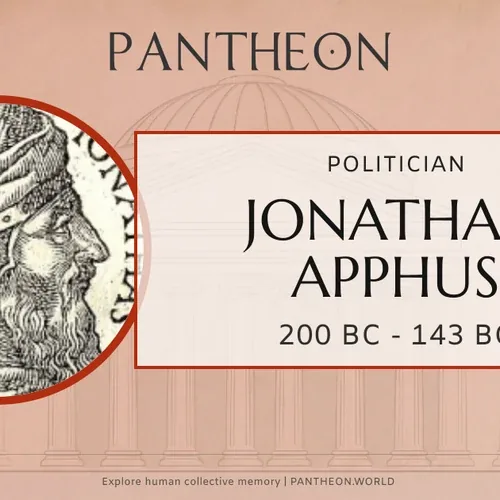
“Leader of the Hasmonean dynasty from 160 to 143 BCE”
Jonathan Apphus was one of the sons of Mattathias and the leader of the Hasmonean dynasty of Judea from 160 to 143 BCE.
Following the death of Judas Maccabeus in battle at Elasa, the Maccabean rebellion was pushed to the brink of collapse, confined to marshes east of the Jordan while Seleucid-backed Hellenists regained control of Jerusalem.
Jonathan preserved the rebellion through shrewd guerrilla tactics and diplomacy, exploited rival claimants to the Seleucid throne to secure imperial recognition as High Priest and military governor of Judea, and consolidated Hasmonean control.
Transformed a precarious guerrilla revolt into an officially recognized political state, combining high priestly authority with political sovereignty.
Alexander Balas appoints Jonathan as High Priest and Friend of the King, bestowing a purple robe and golden crown.
Tracing the downstream transmission from Jonathan Apphus’s initial intervention through immediate adapters, institutionalization, and enduring consequences in human history.
Jonathan preserved the rebellion through shrewd guerrilla tactics and diplomacy, exploited rival claimants to the Seleucid throne to secure imperial recognition as High Priest and military governor of Judea, and consolidated Hasmonean control.
Rulings, codes, and hermeneutic principles incorporated into yeshiva curricula and communal adjudication.
Commentaries, codes, and responsa accepted as authoritative standards by Diaspora communities.
Without Jonathan’s diplomatic finesse, the death of Judas would have marked the total destruction of the Maccabean cause.
How many people, institutions, societies, or disciplines were affected?
Jonathan Apphus: Documents Jonathan’s transition from insurgent commander to sovereign prince recognized across Mediterranean diplomatic treaties.
[1 Maccabees 10:15–21] Alexander Balas appoints Jonathan as High Priest and Friend of the King, bestowing a purple robe and golden crown.
Documents Jonathan’s transition from insurgent commander to sovereign prince recognized across Mediterranean diplomatic treaties.
Integrated into daily liturgy, lifecycle rites, and Jewish constitutional identity worldwide.
Transformed a precarious guerrilla revolt into an officially recognized political state, combining high priestly authority with political sovereignty.
How fundamentally did they alter the structural state of the field or world?
Did the consequences endure decades, centuries, or millennia?
Did they introduce a genuinely new paradigm vs. incremental refinement?
Would this change have happened without this specific individual?
How crucial to Jewish civilization, Torah, ethics, or Israel?
Comprehensive multi-dimensional evaluation of civilizational reach, conceptual depth, duration of legacy, and historical causation across Jewish and world history.