1K
Loading Reference Work…
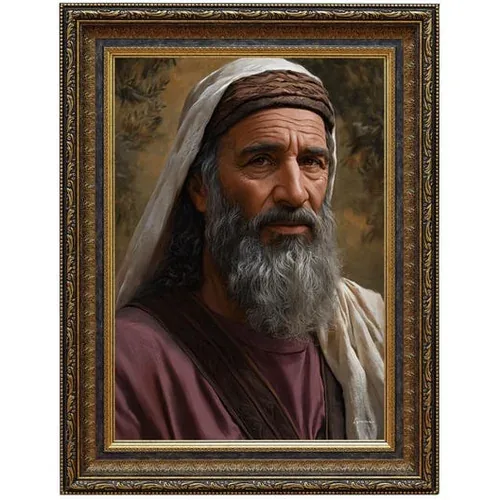
“Biblical patriarch, son of Abraham and Sarah”
Isaac is the second Hebrew patriarch in Judaism and an important figure in the Abrahamic religions, including Samaritanism, Christianity, Islam, the Baháʼí Faith, and Rastafari. Isaac first appears in the Torah, in which he is the son of Abraham and Sarah, the father of Jacob and Esau, and the grandfather of the twelve tribes of Israel.
The nascent monotheistic revelation given to Abraham was entirely vulnerable to dying out in a single generation, surrounded by Canaanite clan warfare, cyclical famines, and human sacrifice cults.
Isaac submitted to the divine test at Mount Moriah (*Akedah*), preserved the Abrahamic covenant within the Promised Land without ever leaving its borders, re-dug the wells of peace (*Beer-sheba*), and transmitted the paternal blessing to Jacob.
Provided the vital generational bridge ensuring the covenant survived its most fragile infancy, establishing the supreme biblical paradigm of humble piety, contemplative devotion (*tefilat minchah*), and peaceful agricultural persistence.
Tracing the downstream transmission from Isaac’s initial intervention through immediate adapters, institutionalization, and enduring consequences in human history.
Isaac submitted to the divine test at Mount Moriah (*Akedah*), preserved the Abrahamic covenant within the Promised Land without ever leaving its borders, re-dug the wells of peace (*Beer-sheba*), and transmitted the paternal blessing to Jacob.
Rulings, codes, and hermeneutic principles incorporated into yeshiva curricula and communal adjudication.
Commentaries, codes, and responsa accepted as authoritative standards by Diaspora communities.
Transmitted the monotheistic covenant and moral archetype.
Patriarchal covenantal blessing and spiritual succession.
Had Isaac perished at Moriah or abandoned Canaan during famine, the Abrahamic enterprise would have ceased immediately, extinguishing ethical monotheism before it ever took root.
How many people, institutions, societies, or disciplines were affected?
Isaac: Explores the theological revolution of Genesis 22 in abolishing child sacrifice practiced by neighboring Phoenician and Canaanite peoples.
[Genesis 22:1–19] The Akedah (Binding of Isaac): the supreme test of covenantal fidelity that decisively condemned and ended human sacrifice in Israel.
[Genesis 26:17–25] Isaac re-digs the wells of Abraham and secures peace with Abimelech at Rehoboth and Beersheba.
The Akedah (Binding of Isaac): the supreme test of covenantal fidelity that decisively condemned and ended human sacrifice in Israel.
Isaac re-digs the wells of Abraham and secures peace with Abimelech at Rehoboth and Beersheba.
Explores the theological revolution of Genesis 22 in abolishing child sacrifice practiced by neighboring Phoenician and Canaanite peoples.
Integrated into daily liturgy, lifecycle rites, and Jewish constitutional identity worldwide.
Provided the vital generational bridge ensuring the covenant survived its most fragile infancy, establishing the supreme biblical paradigm of humble piety, contemplative devotion (*tefilat minchah*), and peaceful agricultural persistence.
How fundamentally did they alter the structural state of the field or world?
Did the consequences endure decades, centuries, or millennia?
Did they introduce a genuinely new paradigm vs. incremental refinement?
Would this change have happened without this specific individual?
How crucial to Jewish civilization, Torah, ethics, or Israel?
Comprehensive multi-dimensional evaluation of civilizational reach, conceptual depth, duration of legacy, and historical causation across Jewish and world history.