1K
Loading Reference Work…
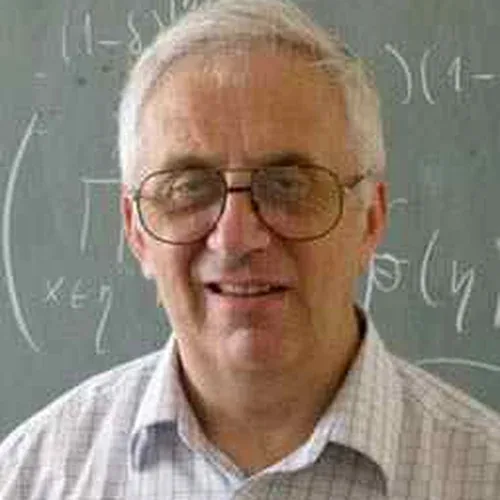
“Russian mathematician”
Grigory Aleksandrovich Margulis is a Russian-American mathematician known for his work on lattices in Lie groups, and the introduction of methods from ergodic theory into diophantine approximation. He was awarded a Fields Medal in 1978, a Wolf Prize in Mathematics in 2005, and an Abel Prize in 2020, becoming the fifth mathematician to receive the three prizes. In 1991, he joined the faculty of Yale University, where he is currently the Erastus L. De Forest Professor of Mathematics.
Practices and discourse in Mathematics & Computer Science were shaped by prevailing generational conventions and historical constraints.
Delivered innovative leadership, foundational insights, or creative works that permanently altered the frontier of Mathematics & Computer Science.
Established precedents, standards of excellence, and cultural milestones that endure in contemporary society.
Tracing the downstream transmission from Grigory Margulis’s initial intervention through immediate adapters, institutionalization, and enduring consequences in human history.
Delivered innovative leadership, foundational insights, or creative works that permanently altered the frontier of Mathematics & Computer Science.
Hypotheses subjected to empirical testing, mathematical formulation, and international peer replication during the Modern Period, 1880–1945.
Formulations integrated into university curricula, national laboratories, and engineering applications.
Without their decisive contributions, the historical development of Mathematics & Computer Science would have unfolded along a more diminished trajectory.
How many people, institutions, societies, or disciplines were affected?
Translated into widespread clinical therapies, computational architectures, or industrial technologies preserving human life.
Established precedents, standards of excellence, and cultural milestones that endure in contemporary society.
How fundamentally did they alter the structural state of the field or world?
Did the consequences endure decades, centuries, or millennia?
Did they introduce a genuinely new paradigm vs. incremental refinement?
Would this change have happened without this specific individual?
How crucial to Jewish civilization, Torah, ethics, or Israel?
Comprehensive multi-dimensional evaluation of civilizational reach, conceptual depth, duration of legacy, and historical causation across Jewish and world history.