1K
Loading Reference Work…
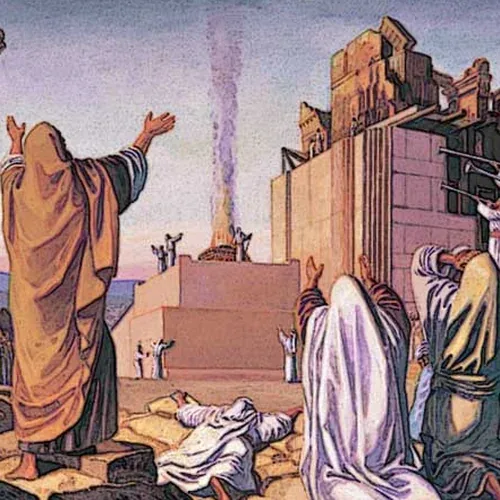
“Figure in early Jewish history”
Ezra is the main character of the Book of Ezra. According to the Hebrew Bible, he was an important Jewish scribe and priest in the early Second Temple period. In the Greek Septuagint, the name is rendered as Ésdrās, from which the Latin name Esdras comes. "Ezra" is probably a shortened Aramaic form of the Hebrew name עֲזַרְיָהוּ, meaning "Yah helps".
The impoverished remnants returning from the Babylonian exile were spiritually disoriented, largely illiterate in sacred Hebrew, and intermarrying with surrounding idol-worshipping populations, threatening communal extinction.
Ezra the Priest-Scribe led an expedition from Babylon to Jerusalem, instituted regular public reading and vernacular translation of the Torah at the Water Gate, standardized Hebrew script (*Ktav Ashuri*), and established the Great Assembly (*Anshei Knesset HaGedolah*).
Re-founded Judaism as a religion centered on universal literacy and study of the written Torah, democratic access to sacred texts, and the institutional framework that birthed the synagogue and Rabbinic Judaism.
Tracing the downstream transmission from Ezra’s initial intervention through immediate adapters, institutionalization, and enduring consequences in human history.
Ezra the Priest-Scribe led an expedition from Babylon to Jerusalem, instituted regular public reading and vernacular translation of the Torah at the Water Gate, standardized Hebrew script (*Ktav Ashuri*), and established the Great Assembly (*Anshei Knesset HaGedolah*).
Rulings, codes, and hermeneutic principles incorporated into yeshiva curricula and communal adjudication.
Commentaries, codes, and responsa accepted as authoritative standards by Diaspora communities.
Primary foundational figure.
Dual restoration of Jerusalem: scriptural canonization and physical wall reconstruction.
Without Ezra, the return from Babylon would have ended in religious dissipation and assimilation into Samaria, aborting Second Temple Judaism and the entire rabbinic tradition.
How many people, institutions, societies, or disciplines were affected?
Ezra: Celebrates Ezra as the father of Second Temple Judaism who made the democratic study of Torah the primary expression of Jewish piety.
[Nehemiah 8:1–8] Ezra reads the Torah aloud from a wooden podium before the entire assembly of men and women, translating it with clarity so they understand.
Ezra reads the Torah aloud from a wooden podium before the entire assembly of men and women, translating it with clarity so they understand.
Celebrates Ezra as the father of Second Temple Judaism who made the democratic study of Torah the primary expression of Jewish piety.
Integrated into daily liturgy, lifecycle rites, and Jewish constitutional identity worldwide.
Re-founded Judaism as a religion centered on universal literacy and study of the written Torah, democratic access to sacred texts, and the institutional framework that birthed the synagogue and Rabbinic Judaism.
How fundamentally did they alter the structural state of the field or world?
Did the consequences endure decades, centuries, or millennia?
Did they introduce a genuinely new paradigm vs. incremental refinement?
Would this change have happened without this specific individual?
How crucial to Jewish civilization, Torah, ethics, or Israel?
Comprehensive multi-dimensional evaluation of civilizational reach, conceptual depth, duration of legacy, and historical causation across Jewish and world history.