1K
Loading Reference Work…
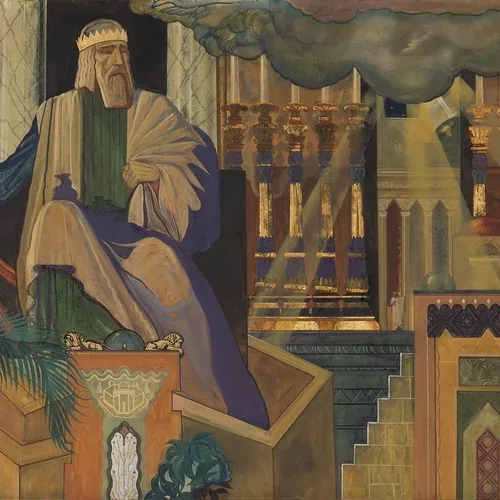
“Biblical figure and Israelite monarch”
David was, originally, leader of the Tribe of Judah who became the second king of the united Kingdom of Israel, according to the Hebrew Bible and Old Testament.
The twelve tribes of Israel lived as a fragile, loose pastoral confederation constantly vulnerable to Philistine iron weaponry, internal blood feuds, and spiritual oscillation without a unified political capital or enduring sanctuary.
David conquered the neutral Jebusite fortress of Jerusalem, unified the northern and southern tribes into a single centralized monarchy, retrieved the Ark of the Covenant, and established the permanent Davidic covenant (*Brit David*), composing the core of the Psalms.
Made Jerusalem (*Zion*) the eternal spiritual and political capital of the Jewish people, instituted the archetype of the righteous monarch whose lineage anchors the biblical Messianic promise in both Judaism and Christianity, and created the devotional hymnbook of the Western world.
Tracing the downstream transmission from David’s initial intervention through immediate adapters, institutionalization, and enduring consequences in human history.
David conquered the neutral Jebusite fortress of Jerusalem, unified the northern and southern tribes into a single centralized monarchy, retrieved the Ark of the Covenant, and established the permanent Davidic covenant (*Brit David*), composing the core of the Psalms.
Rulings, codes, and hermeneutic principles incorporated into yeshiva curricula and communal adjudication.
Commentaries, codes, and responsa accepted as authoritative standards by Diaspora communities.
Anointed David as enduring king of Israel in Bethlehem.
Transmitted the unified monarchy, Jerusalem sanctuary plan, and psalmodic legacy.
Without David, the Israelite tribes would almost certainly have been assimilated or permanently subjugated by Philistine city-states, Jerusalem would have remained an obscure Canaanite stronghold, and the messianic theological framework uniting Judaism and Christianity would have had no historical foundation.
How many people, institutions, societies, or disciplines were affected?
David: Analyzes the historiographical transition from charismatic chieftainship to statehood in 1-2 Samuel and the profound liturgical legacy of the Psalter.
David: Notes how the biblical portrayal of David balances military heroism and genuine piety against honest depictions of moral frailty and palace intrigue.
[2 Samuel 7:8–16] The Davidic Covenant: God promises David an eternal dynasty, throne, and kingdom, laying the ground for Messianic theology.
The Davidic Covenant: God promises David an eternal dynasty, throne, and kingdom, laying the ground for Messianic theology.
The iconic psalm of divine protection and intimacy ("The Lord is my shepherd; I shall not want").
Analyzes the historiographical transition from charismatic chieftainship to statehood in 1-2 Samuel and the profound liturgical legacy of the Psalter.
Notes how the biblical portrayal of David balances military heroism and genuine piety against honest depictions of moral frailty and palace intrigue.
Integrated into daily liturgy, lifecycle rites, and Jewish constitutional identity worldwide.
Made Jerusalem (*Zion*) the eternal spiritual and political capital of the Jewish people, instituted the archetype of the righteous monarch whose lineage anchors the biblical Messianic promise in both Judaism and Christianity, and created the devotional hymnbook of the Western world.
How fundamentally did they alter the structural state of the field or world?
Did the consequences endure decades, centuries, or millennia?
Did they introduce a genuinely new paradigm vs. incremental refinement?
Would this change have happened without this specific individual?
How crucial to Jewish civilization, Torah, ethics, or Israel?
Comprehensive multi-dimensional evaluation of civilizational reach, conceptual depth, duration of legacy, and historical causation across Jewish and world history.
[Psalms 23:1–6] The iconic psalm of divine protection and intimacy ("The Lord is my shepherd; I shall not want").