1K
Loading Reference Work…
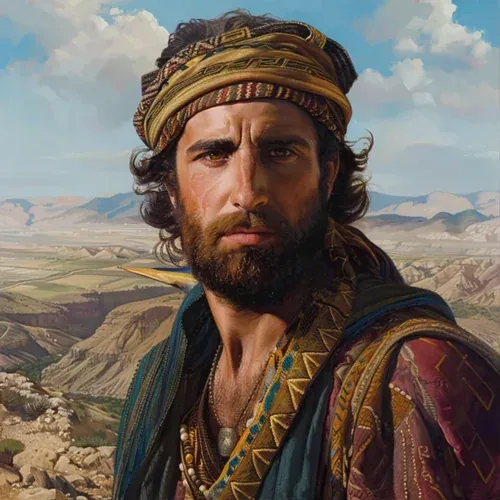
“Biblical character”
Caleb is a figure who appears in the Hebrew Bible as a representative of the Tribe of Judah during the Israelites' journey to the Promised Land.
Paralyzed by existential fear following the scouting of Canaan, ten of the twelve tribal leaders incited national rebellion against God and Moses, demanding a return to Egyptian slavery.
Caleb stood alongside Joshua, quieted the panicked multitude with the ringing declaration "Let us by all means go up, and we shall gain possession of it," held steadfast faith, and forty-five years later conquered the giant Anakim at Hebron at age eighty-five.
Exemplified the indispensable biblical virtue of moral courage (*ruach acheret* / "a different spirit") that rejects majority consensus when it conflicts with divine promise, securing Hebron as the spiritual heartland of Judah.
Tracing the downstream transmission from Caleb’s initial intervention through immediate adapters, institutionalization, and enduring consequences in human history.
Caleb stood alongside Joshua, quieted the panicked multitude with the ringing declaration "Let us by all means go up, and we shall gain possession of it," held steadfast faith, and forty-five years later conquered the giant Anakim at Hebron at age eighty-five.
Rulings, codes, and hermeneutic principles incorporated into yeshiva curricula and communal adjudication.
Commentaries, codes, and responsa accepted as authoritative standards by Diaspora communities.
Without Caleb’s decisive intervention to quiet the congregation and stand against despair, the scouting crisis could have triggered total collapse or immediate divine destruction of the camp in the wilderness.
How many people, institutions, societies, or disciplines were affected?
Caleb: Examines Caleb’s character as the Kenizzite-Judahite hero whose unflinching loyalty earned an eternal blessing for his clan.
[Numbers 13:30–14:9] Caleb silences the people before Moses and urges immediate trust in God to conquer Canaan.
[Joshua 14:6–14] Caleb recounts his wholehearted devotion at age eighty-five and claims Hebron as his covenantal inheritance.
Caleb silences the people before Moses and urges immediate trust in God to conquer Canaan.
Caleb recounts his wholehearted devotion at age eighty-five and claims Hebron as his covenantal inheritance.
Examines Caleb’s character as the Kenizzite-Judahite hero whose unflinching loyalty earned an eternal blessing for his clan.
Integrated into daily liturgy, lifecycle rites, and Jewish constitutional identity worldwide.
Exemplified the indispensable biblical virtue of moral courage (*ruach acheret* / "a different spirit") that rejects majority consensus when it conflicts with divine promise, securing Hebron as the spiritual heartland of Judah.
How fundamentally did they alter the structural state of the field or world?
Did the consequences endure decades, centuries, or millennia?
Did they introduce a genuinely new paradigm vs. incremental refinement?
Would this change have happened without this specific individual?
How crucial to Jewish civilization, Torah, ethics, or Israel?
Comprehensive multi-dimensional evaluation of civilizational reach, conceptual depth, duration of legacy, and historical causation across Jewish and world history.