1K
Loading Reference Work…
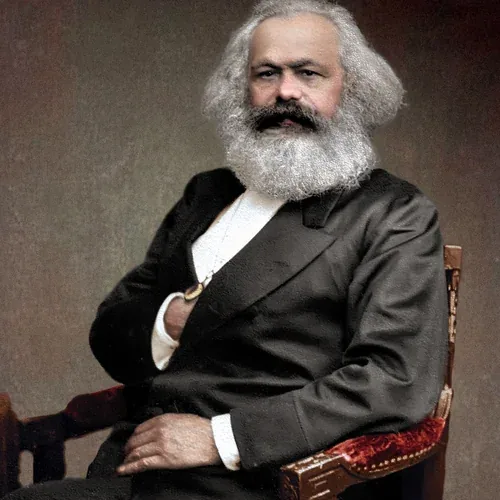
The philosopher, political economist, and social theorist whose critique of capitalism and theory of historical materialism transformed global politics, economics, and history in the 19th and 20th centuries.
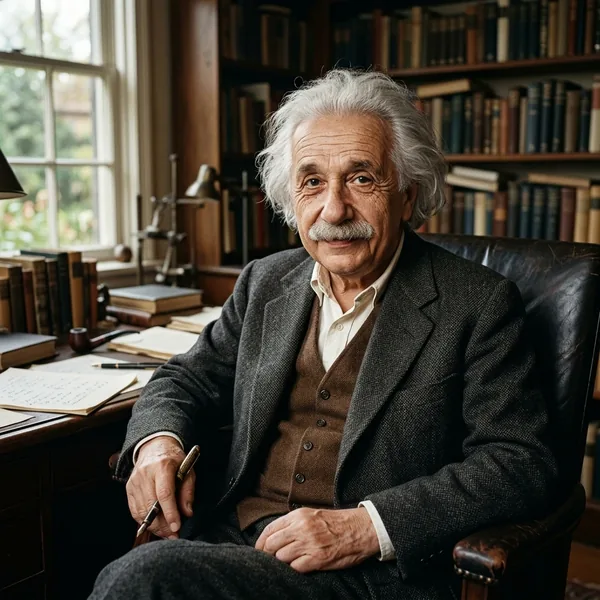
The greatest theoretical physicist of the modern era, who fundamentally revolutionized humanity’s understanding of space, time, gravity, energy, and the quantum universe.
Social and political theory explained historical development through political decrees, religious ideals, or Hegelian spiritual dialectics, largely detached from material modes of production.
Formulated historical materialism and scientific critique of capitalism, identifying class struggle and capital accumulation as the primary engines driving human societal evolution.
Transformed global geopolitics, sociology, labor rights, macroeconomics, and philosophy, providing the ideological foundation for major revolutions and social democratic welfare states across the 20th and 21st centuries.
Classical Newtonian physics rested on absolute time and Euclidean three-dimensional space, leaving electrodynamics, the constancy of light speed, and mercury orbital anomalies unexplained.
Formulated Special and General Relativity, proved the photon quantum hypothesis via the photoelectric effect, and derived mass-energy equivalence (E=mc²), permanently revolutionizing modern cosmology and quantum foundations.
The cosmic architecture of the universe was unified into dynamic curved spacetime, enabling quantum optics, atomic energy, astrophysics, GPS satellite networks, and the modern standard model.