1K
Loading Reference Work…

The literary visionary of modern alienation, bureaucratic tyranny, and existential dread, whose surreal masterpieces captured the psychological condition of the 20th century.
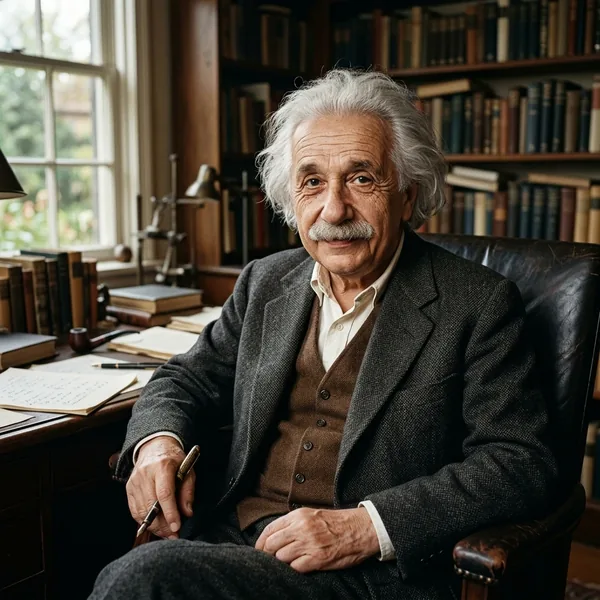
The greatest theoretical physicist of the modern era, who fundamentally revolutionized humanity’s understanding of space, time, gravity, energy, and the quantum universe.
Modernist literature focused on realist psychological drama or bourgeois social critique, unable to capture the surreal, labyrinthine, and absurd alienation of modern bureaucratic existence.
Created an entirely new literary mode—"Kafkaesque"—depicting modern individuals trapped within nightmarish, opaque, and arbitrary institutional labyrinths without guilt, recourse, or explanation.
Redefined 20th-century world literature, existential philosophy (Camus, Sartre), Latin American magical realism (García Márquez), and sociology, providing the defining archetype of modern existential dread.
Classical Newtonian physics rested on absolute time and Euclidean three-dimensional space, leaving electrodynamics, the constancy of light speed, and mercury orbital anomalies unexplained.
Formulated Special and General Relativity, proved the photon quantum hypothesis via the photoelectric effect, and derived mass-energy equivalence (E=mc²), permanently revolutionizing modern cosmology and quantum foundations.
The cosmic architecture of the universe was unified into dynamic curved spacetime, enabling quantum optics, atomic energy, astrophysics, GPS satellite networks, and the modern standard model.